

1. Principles and theories
Service Simulation is a 360-degree learning process by using examples from real situations to simulate virtual events for collaborative learning within the organization to develop, design, improve and modify work processes through crystallizing analytical ideas from virtual events that will allow participants in the event to gain experiences from various dimensions of perspectives and facts from what happened according to the context of the event.
ทำไม Service Simulation ดีกว่าRole Play

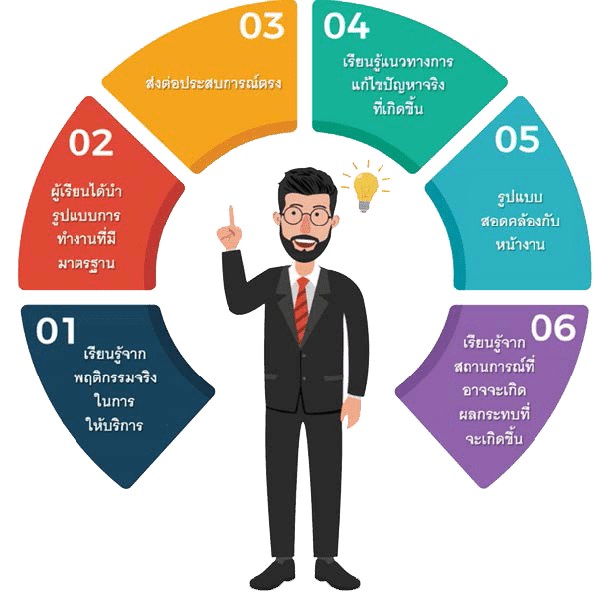
- 1. See – events or situations that actually happened from various perspectives.
- 2. Heard – Conversations and words spoken between customers and employees throughout the incident.
- 3. Listen to understand – understand the actual situation at work, including the employees’ problem-solving approach.
- 4. Understanding – Some of the content or issues that may have been overlooked, including what should be improved and further developed so that the content design can be used and truly beneficial to the organization’s team in the most appropriate way.
- 5. Build skills – Learning patterns that build understanding will create positive lifelong skills that will last a lifetime.
We will be part of the event until we reach a conclusion that has been thoroughly thought out.
and lead to the development, design or improvement of the process to achieve maximum efficiency
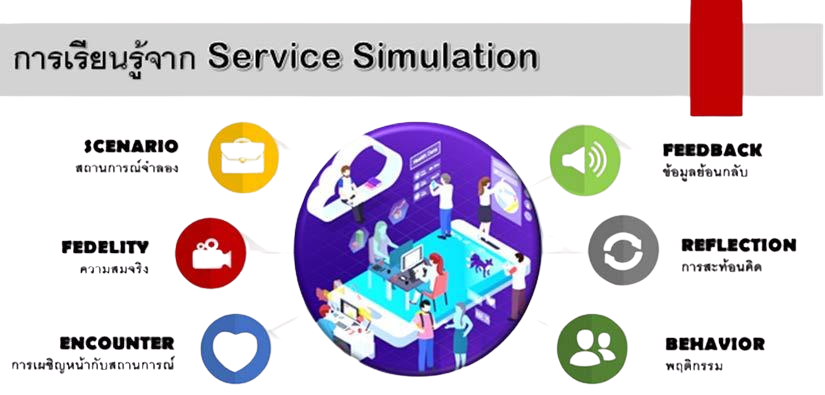
Debriefing is a process of stimulating thinking to analyze development or solve problems correctly and appropriately by asking questions, gathering all relevant issues to thoroughly understand the incident. Debriefing is a process that the medical community worldwide gives importance to and is most commonly used in considering and analyzing situations to stimulate thinking in developing work plans correctly, accurately, and covering the impact. It will arise from joint discussions on various skills that will be used to the full potential of the participants in the process, such as:
- 1. Observation skills
- 2. Situation assessment
- 3. Collection of issues
- 4. Listening skills
- 5. Communication skills
- 6. Stimulating thoughts
- 7. Asking positive questions
- 8. Reverse analysis of all-round data
The importance of learning by doing
Service Simulation & DebriefingTechniques
Mostly, learning in this form, if compared between organizations and agencies, will have different results because the steps and processes are clearly different. But what is beneficial in principle will be important as follows:
2. Objective
- 1. To learn about service delivery models, service simulation models and practice in collecting issues to develop thinking and working skills.
- 2. To develop effective organizational learning.
- 3. To be applied to the development of the organization's service model.
- 4. Apply the principles to the application and development of the organization.
- 5. Develop leaders' potential to see the big picture, solve problems and develop the organization.
3. Methodology
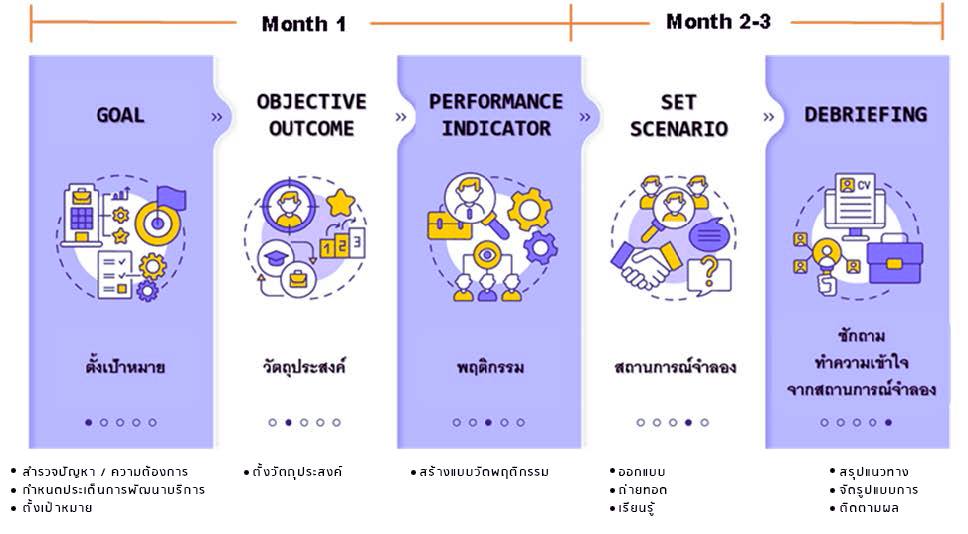
Overall Operation Process
The starting point for creating Service Simulation & Debriefing Techniques should be to clearly define the process so that the direction is set correctly and appropriately for the organization, which will result in the most efficient operation until the overall picture of the entire operation process can be seen.
4. Related persons
All levels of employees who wish to improve the quality of their service standards (students who complete the course will receive a certificate from the institute)
5. Number of people per generation
1 agency: 15 people
6. Documents received
- Learning Documents
- Service Simulation Behavior Assessment
- Service Debriefing Skill Assessment
- Service Debriefing Questions

7. The results obtained
- The organization has truly improved its service level.
- The customer service staff who have passed the course will have the skills to deliver high-quality services.
- The organization has a mechanism to develop personnel skills with universal techniques such as Service Simulation.
Q&A
• Service simulation is realistic and in a real or virtual environment, so that participants feel as if they are facing a real situation, allowing them to demonstrate service behaviors that are close to reality.
• Service Simulation is the transfer of experience from participating in simulations from those who have experience from learning from observing actual practice and reflecting on the learner’s own actions, so it creates real experience and can be applied in real situations in practice.
• Service Simulation learns from mistakes from participating in simulations, which are caused by the learner’s own thought processes, so it causes the learner to reflect on himself to find ways to develop and accept and adapt to changes that occur in planning future work behaviors.
• Service Simulation uses many concepts and processes in learning and psychology to develop the potential of personnel, such as learning from experience, learning from integrated thinking situations, and reflecting on the learner’s own thoughts with the Facilitator process.
• Coaching is a technique that is part of Debriefing during the questioning and finding additional answers. Debriefing itself will combine many techniques to achieve the most efficiency after the situation. It consists of the Coaching Facilitating Mentoring format, including the use of questions that ask about feelings, ask doubts, ask opinions from the situation with the learner’s conversation group by using open-ended questions and using stimulating questions to create reflection from the learner (Self-Reflection), causing careful reflection. Look back on the issue to change the experience in that matter into learning and knowledge that will be further developed in working effectively.
• It can be made into a training course and is a more effective course than normal training, which is mostly in the form of lecture-based training and workshops. Service Simulation is a form of knowledge and workshops related to actual work (on the job training), emphasizing
Learning from actual work experiences (Experiential Learning) and using debriefing techniques to enable learners to have the behaviors that the organization wants and be able to use
That behavior to further develop their own potential and the organization.
• It can be made into a training course and is a more effective course than normal training, which is mostly in the form of lecture-based training and workshops. Service Simulation is a form of knowledge and workshops related to actual work (on the job training), emphasizing
Learning from actual work experiences (Experiential Learning) and using debriefing techniques to enable learners to have the behaviors that the organization wants and be able to use
That behavior to further develop their own potential and the organization.
• Continuously organize Service Simulation training 1-2 times a year to create a systematic behavioral change process so that employees gain knowledge and understanding to create behaviors that meet the specified objectives and develop their abilities to the point of developing skills and expertise.
• Set standard behaviors obtained from Service Simulation in the Roadmap for measuring the organization’s competency to assess work behaviors in each assessment, such as annual assessments.
• Arrange for a Facilitator in the organization to continuously assess and monitor employee performance behaviors. Arrange for an assessment of Facilitator standards by the unit that organizes the training to create sustainable standards.
• Continuously consult with the unit that organizes the training (Consultant) to follow up on the results and find ways to adjust strategies for continuous work development.
• When organizing training that provides knowledge and experience in accordance with the organization’s objectives
• When creating psychological safety in learning (Psychological Safety) in order to respond positively to learning activities and the learning environment and expressing opinions freely to develop ideas without limits
• When employees are required to have the ability to be self-aware to face what happens from work in terms of controlling emotions, thoughts and behaviors that are expressed
• When employees are required to increase their self-confidence (Self-Confidence), which is an important element in making decisions in providing services and is necessary for performing services with quality
• When employees are required to increase decision-making skills (Decision Making) to help make better decisions and help change behaviors and perspectives in dealing with problems at work effectively
• When employees are required to have self-reflection, have observation skills, analyze themselves in what are their strengths and points that can be used to develop and develop their potential and the organization further